
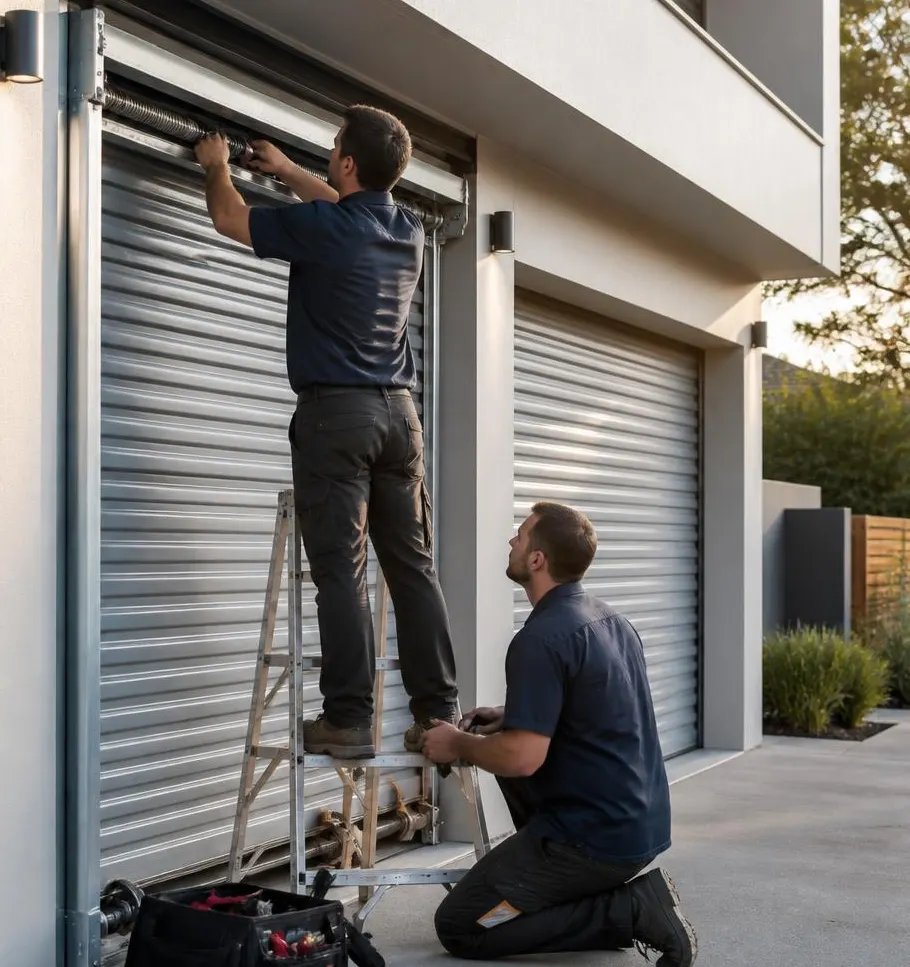
It usually starts the same way. One of you hits the remote, the door comes down, and three inches from the floor it stops, shudders, and goes right back up. Or worse — it slams down hard enough to rattle the windows. One spouse says "the opener's broken, we need a new one." The other says "it's fine, you just bumped the button wrong." You're both a little right, and the actual answer has nothing to do with either theory — it's the force and travel limit settings on the opener itself.
What Travel Limits Actually Do
Travel limits tell the opener exactly how far to move the door before stopping — one point for fully open, one point for fully closed. Think of them as the opener's internal ruler. If the "closed" limit is set too short, the door stops short of the floor and looks like it's reversing on its own. If it's set too long, the opener keeps straining the door downward after it's already seated, which stresses the bottom panel and the track brackets.
Travel limits aren't a one-time, forget-it setting in this climate. Wood and composite garage doors absorb humidity and swell slightly during Florida's hot, wet months, which changes how far the door actually needs to travel to seat properly. A limit that was perfect in a dry spell can be off by enough to cause a visible gap at the bottom — which matters when afternoon downpours are rolling through and that gap is letting water and bugs into the garage.
What Force Limits Actually Do
Force limits are different. This setting controls how hard the opener will push or pull before it decides something is blocking the door and reverses for safety. Every opener sold in the U.S. has to include this auto-reverse feature — it's what keeps a door from closing on a kid's bike, a pet, or a foot.
When the force is set too high, the opener will push through resistance it should be stopping for. That's the scenario where the door doesn't reverse off a stray object on the track, or grinds through a bent roller instead of stopping. It's also just hard on the hardware — the motor, belt or chain, and the door panels themselves take more abuse every single cycle.
When the force is set too low, the door reverses constantly for no obvious reason — a little resistance from a stiff hinge, a slightly bent track, or just normal friction on a humid day is enough to trigger it. That's usually the "it's broken" complaint, when really the opener is doing exactly what it's supposed to do: refusing to force a door that's struggling to move.
Why Cranking Up the Force Is the Wrong First Move
It's tempting to just turn the force dial up until the reversing stops. That's also the single most common way homeowners turn a minor problem into an expensive one. If a door is reversing because the springs are worn and no longer counterbalancing the door's weight properly, increasing the force doesn't fix anything — it just makes the opener do the spring's job. That extra strain shortens the life of the motor, stresses the panels, and in a worst case, it overrides the safety reversal right when it matters most.
The right order of operations is: check the springs and rollers first, make sure the track is straight and the door moves smoothly by hand with the opener disconnected, and only then dial in force and travel settings to match.
A Simple Way to Check Yours
- Disconnect the opener (pull the red release cord) and lift the door by hand. It should move smoothly and stay roughly level wherever you let go. If it's heavy, drops fast, or feels uneven, that's a spring issue — not an opener setting.
- Reconnect the opener and watch a full open-close cycle. Note exactly where it stops, reverses, or struggles.
- Place a 2x4 flat on the ground under the door and close it. The opener should reverse immediately on contact. If it doesn't, the force is set too high and needs to come down — this is a real safety issue, not a convenience setting.
- Adjust travel limits in small increments (most openers use small dials, screws, or a menu button on the motor unit) and re-test after each change rather than guessing at a big adjustment.
Why This Matters More in Hurricane Season
Garage doors here are built to meet wind-load requirements, which means the door, track, and hardware are all engineered to work together under pressure. An opener fighting against limits that are out of adjustment — or forcing a door with tired springs — puts extra stress on a system that may already be absorbing wind pressure during a storm. Getting the settings right before storm season winds pick up isn't cosmetic; it's part of keeping the whole door assembly working the way it was designed to.
When to Call Howey-in-the-Hills Garage Door Service
If you've checked the springs, the door moves smoothly by hand, and the opener is still reversing early, slamming, or refusing to seal all the way — that's when it's worth having a technician take a look rather than keep guessing with the dials. We handle Garage Door Opener Installation and adjustment, and if the real issue turns out to be worn springs or a door that's drifted off track, our Garage Door Spring Repair and Off Track Door Repair services get the door itself working correctly again so the opener isn't compensating for a mechanical problem.
If your garage door in Howey-in-the-Hills, FL has been fighting with you all season, give us a call — we'll check the springs, tracks, and opener settings together and get it closing right the first time.